
Welcome - Community Engagement
This page provides downloadable community engagement resources in English and other languages. Use the menu below to browse the materials, and please reach out if you have questions or need additional information.
| Acronym | Meaning | Acronym | Meaning |
| AAI | All Appropriate Inquiries | APZ | Aquifer Protection Zone |
| ABCA | Analysis of Brownfield Cleanup Alternatives | ATSDR | Agency for Toxic Substances and Disease Registry |
| ACCD | Agency of Commerce and Community Development | AST | Above-Ground Storage Tank |
| ACS | American Community Survey | ASTM | American Society for Testing and Materials |
| ACRES | Assessment, Cleanup and Redevelopment Exchange System | BAC | Brownfield Advisory Committee |
| APA | Aquifer Protection Area | BI | Brownfields Inventory |
| Acronym | Meaning | Acronym | Meaning |
| CEJST | Climate and Economic Justice Screening Tool | CT DECD | Connecticut Department of Economic & Community Development |
| CEQ | Council on Economic Quality | CT DEEP | Connecticut Department of Energy and Environmental Protection |
| CERCLA | Comprehensive Environmental Response, Compensation and Liability Act | CT DPH | Connecticut Department of Public Health |
| CDC | Center for Disease Control | CWA | Clean Water Act |
| CIMC | Cleanups in My Community | DEEP | Connecticut Department of Energy & Environmental Protection |
| COG | Council of Governments | DEQ | Department of Environmental Quality |
| Acronym | Meaning | Acronym | Meaning |
| EC | Engineering Control | FIRM | Flood Insurance Rate Map |
| ECHO | Enforcement and Compliance History Online | FS | Feasibility Study |
| EJ | Environmental Justice | FY | Fiscal Year |
| EPA | Environmental Protection Agency | GIS | Geographic Information System |
| EPCRA | Emergency Planning and Community Right to Know Act | HSDB | Hazardous Substance Data Bank |
| FDA | Food and Drug Administration | ICMA | International City/County Management Association |
| FEME | Federal Emergency Management Agency | ID | Identification |
| Acronym | Meaning | Acronym | Meaning |
| LA | Low Access | MAC | Multipurpose, Assessment, Cleanup Grants |
| LBA | Land Bank Authority | MA DEP | Massachusetts Department of Environmental Protection |
| LEP | Licensed Environmental Professional | MAP | Municipal Assistance Program |
| LLP | Landowner Liability Protection | MA OEJE | Massachusetts Office of Environmental Justice & Equity |
| LUST | Leaking Underground Storage Tank | ME DEP | Maine Department of Environmental Protection |
| MW | Monitoring Well |
| Acronym | Meaning | Acronym | Meaning |
| NDDB | Natural Diversity Database | PCB | Polychlorinated Biphenyl |
| NFIP | National Flood Insurance Program | POCD | Plan of Conservation and Development |
| NFWF | National Fish and Wildlife Foundation | RCP | Representative Concentration Pathway |
| NHDES | New Hampshire Department of Environmental Services | RDC | Regional Development Corporations |
| NOAA | National Oceanic and Atmospheric Administration | RI DEM | Rhode Island Department of Environmental Management |
| NRC | National Research Center, Inc. | RLF | Revolving Loan Fund |
| NRCS | Natural Resources Conservation Service | RME | Reasonable Maximum Exposure |
| NWI | National Wetlands Inventory | RPC | Regional Planning Coordinator |
| OPA | Oil Pollution Act | RPO | Regional Planning Officer |
| Acronym | Meaning | Acronym | Meaning |
| SEEDS | Stakeholders, Education, Empowering, Disseminating, Sustainable | USDA | United States Department of Agriculture |
| SF | Square Feet | US EPA | United States Environmental Protection Agency |
| SVI | Social Vulnerability Index | USFWS | United States Fish and Wildlife Service |
| TAB | Technical Assistance to Brownfields | USGS | United States Geological Survey |
| TBA | Targeted Brownfield Assessments | VT DEC | Vermont Department of Environmental Conservation |
| TSCA | Toxic Substances Control Act | WPCA | Water Pollution Control Authority |
| UConn TAB | University of Connecticut EPA Region 1 Technical Assistance to Brownfields Program | WSS | Web Soil Survey |
| UST | Underground Storage Tank |

“SEEDS” Framework:
Introducing SEEDS: This is UConn TAB’s framework for community engagement. It outlines different steps for meaningfully involving local residents in your brownfields projects. Download the SEEDS Framework here.
Click the 'Resources' tab below to download our educational materials and resources.

Finding diverse Stakeholders

Education

Empowering your community
Disseminating important information

Practicing Sustainable Outreach
Resources
Resources
- Story map
- Translation services

This flyer is downloadable as a PDF file when clicking.
This image is an educational infographic about brownfields. It’s designed to explain, in a clear and visual way, what brownfields are, why they matter, and how they can be reused.
What it is used for:
- Educating community members, local officials, and stakeholders
- Raising awareness about brownfields and redevelopment opportunities
- Explaining EPA-supported brownfield programs in simple terms
- Encouraging community involvement and input in redevelopment efforts
Overall, the image is a public outreach and education tool meant to help communities understand brownfields and how they can turn neglected properties into safe, productive spaces. We can turn this brownfields 101 info into any form of educational materials (social media post, flyer, pamphlet, newspaper article, letter, email, poster, and more).
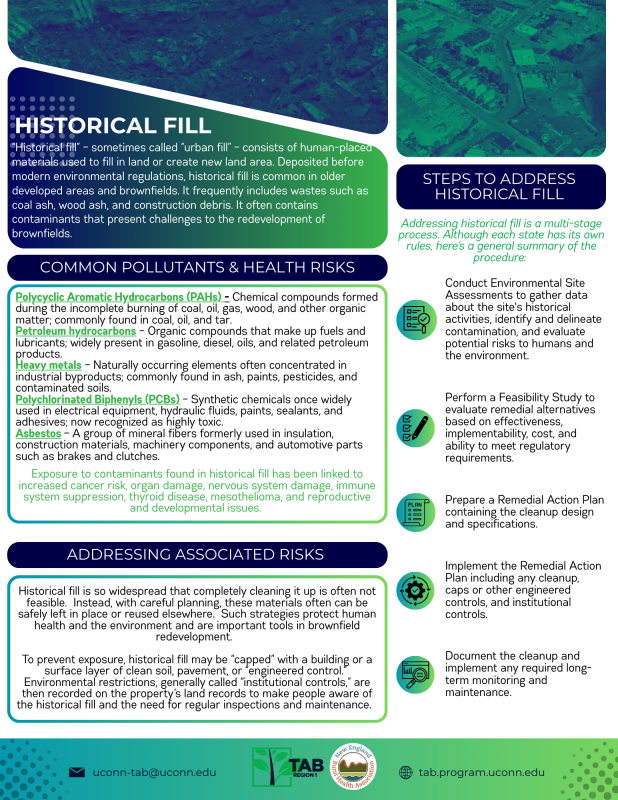
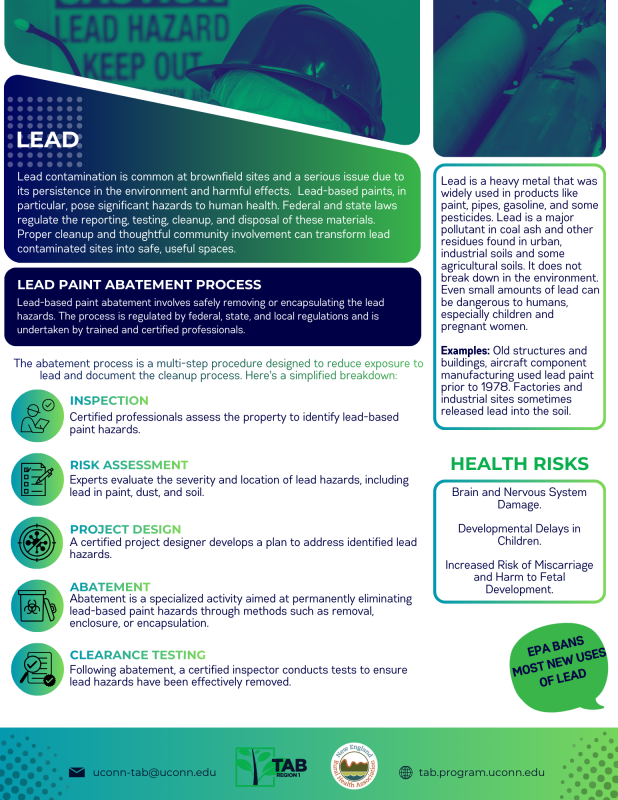

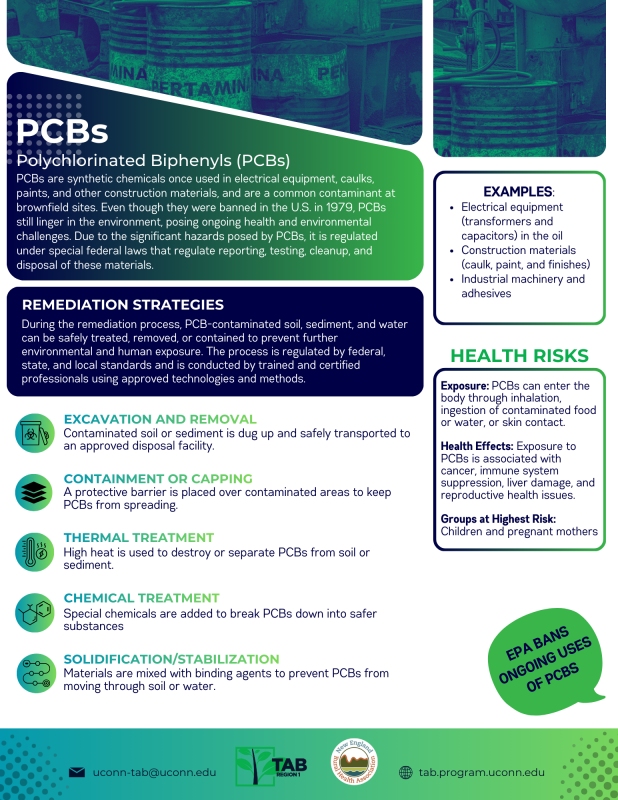
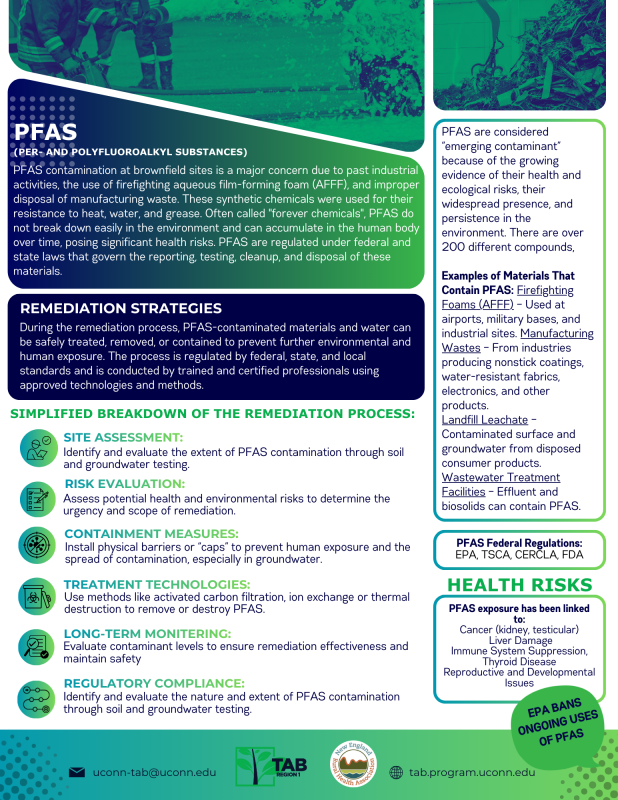

Brownfields Factsheets
Each slide is downloadable as a PDF file when clicking.
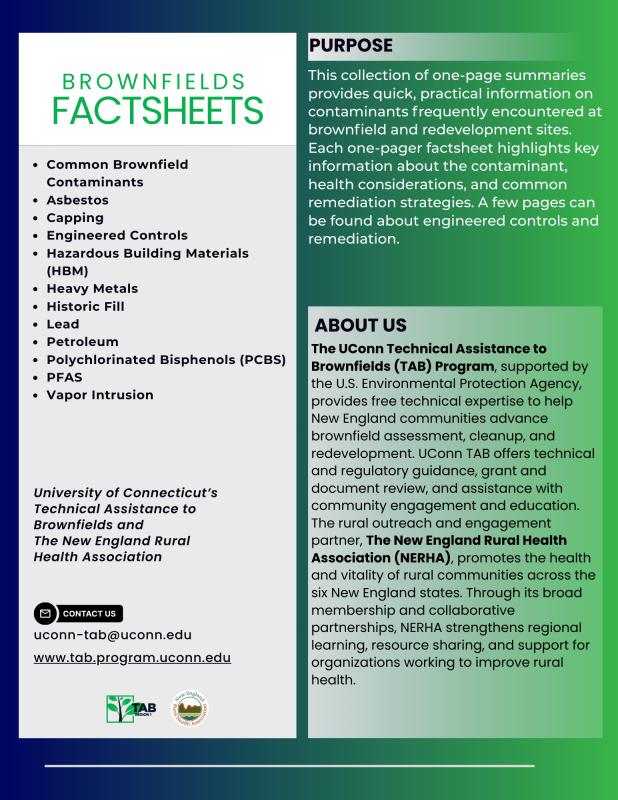
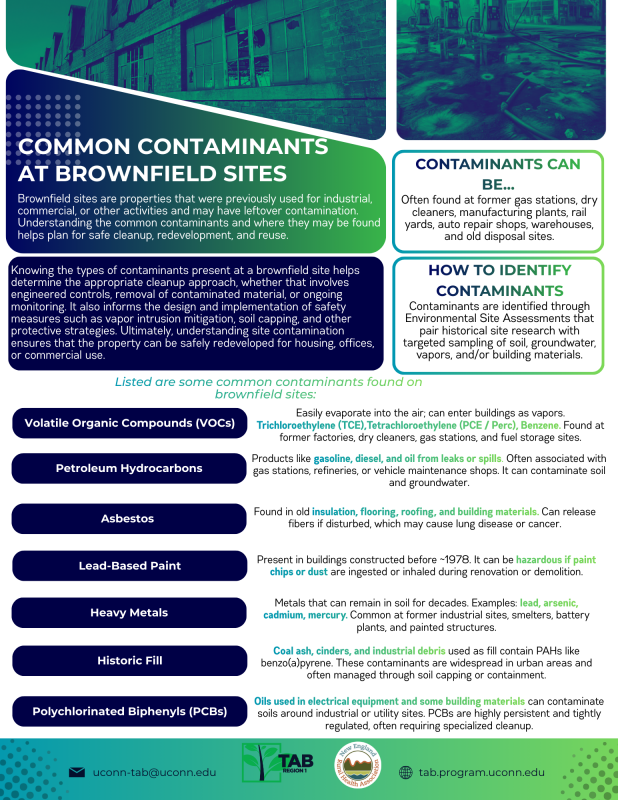
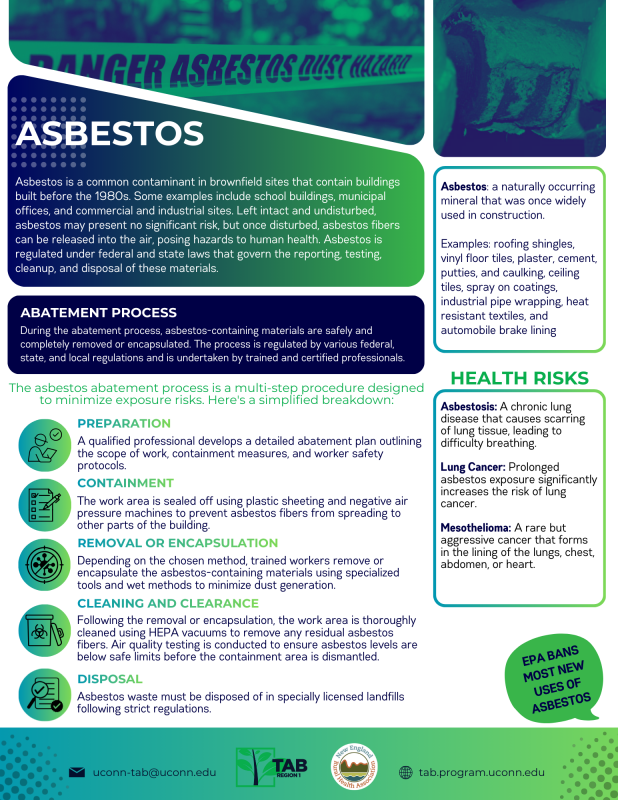
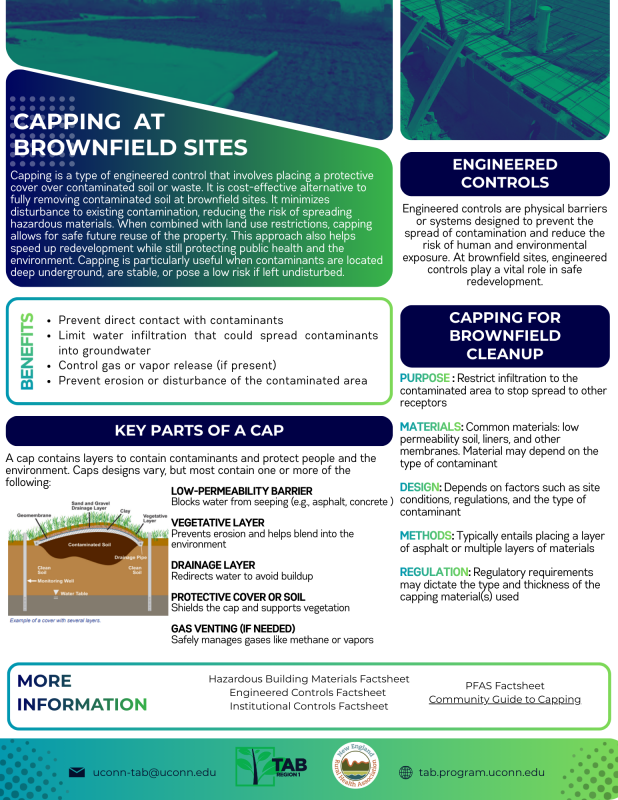
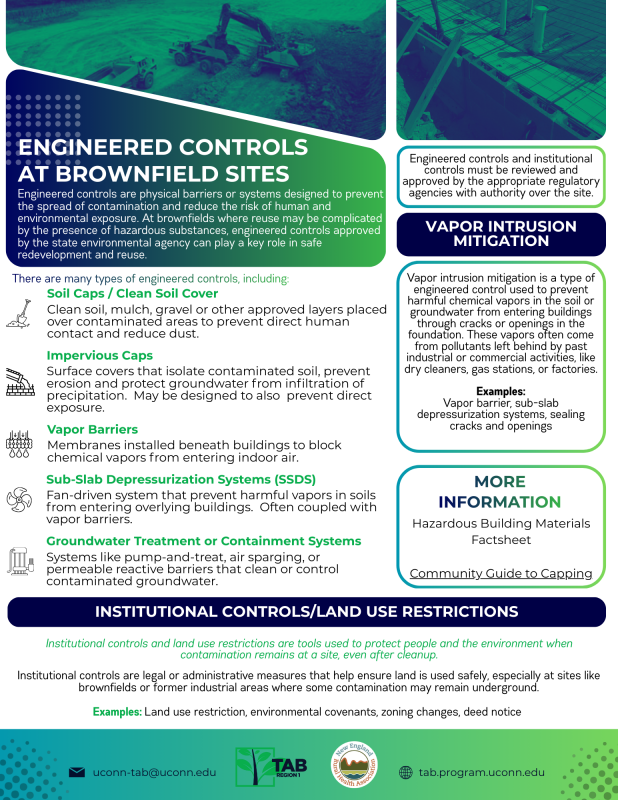
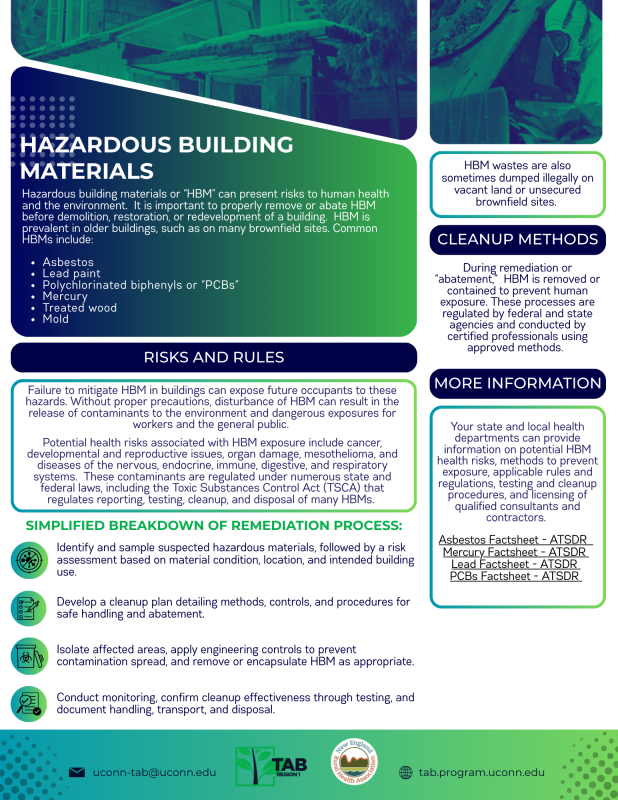
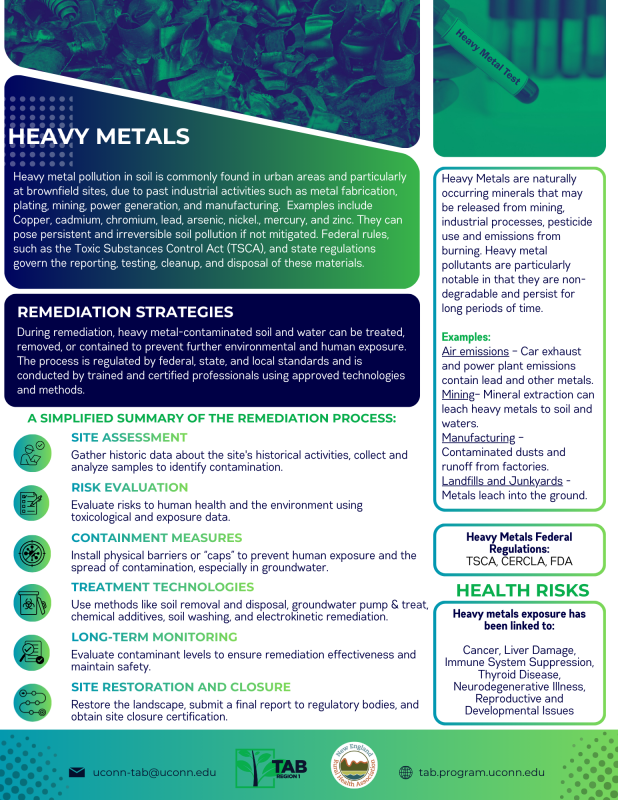
This collection of one-page summaries provides quick, practical information on contaminants frequently encountered at brownfield and redevelopment sites:
In need of translation?
Through our partnership with Fox Translation, we offer translation services for documents and written text in a wide range of languages. These services are intended to support clear and accurate communication by translating content while preserving its original meaning and context. Click the banner below and fill out the form to get started. Submit what you would like translated: social media post, text blurb, document, website content.
If you have any questions, email us at uconn-tab@uconn.edu.

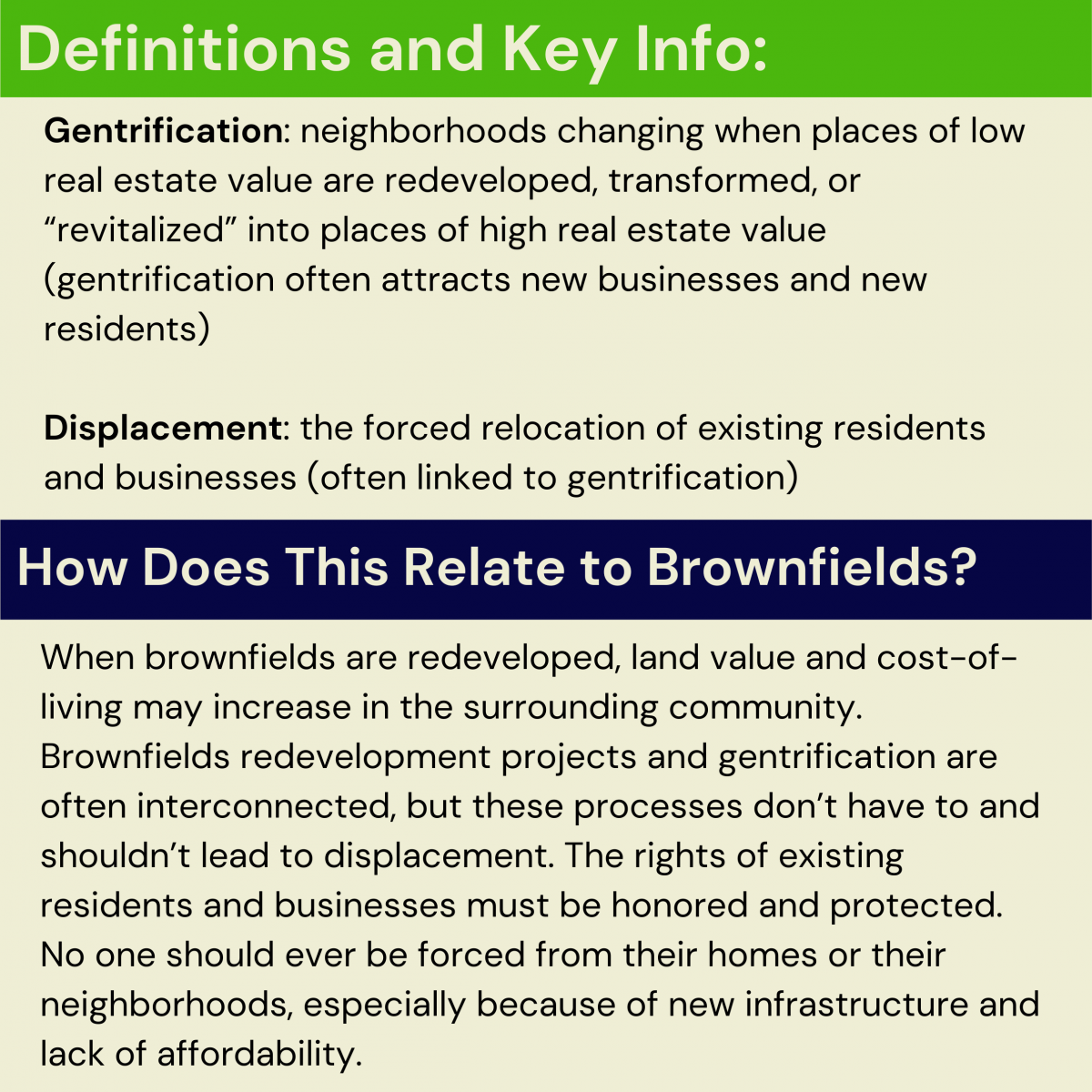
Anti-Displacement Strategies:
Click on the green links below for a more detailed description of each strategy, details on implementation, tips for success, and planning questions:
- Community Benefits Agreement: a contract between community members (or a community organization representing the needs of community members) and a private developer. This contract outlines community needs, desired outcomes and benefits, and how funding will be used both during construction and after the development project is completed
- Community Land Trust: when a nonprofit purchases housing or land specifically to rent or sell the units to local residents at an affordable price, ensuring long-term, sustainable housing
- Inclusionary Zoning: a local policy within a community’s local zoning regulations that requires a certain number of affordable housing units to be set aside for people and families under the average median income
- Small Business Preservation Programs: programs intended to support small businesses through funding, workforce development, or other assistance
- Tax Abatement: financial programs and tax reductions designed to help residents and small businesses stay in their neighborhoods
Community Engagement and EPA MAC Grants
September 20, 2023
This webinar provides a brief overview on community engagement and how to understand / discuss this important topic for your EPA MAC grants.
Identifying and Addressing Displacement
October 18, 2023
This webinar goes into more detail on displacement and how it impacts communities, how it relates to brownfields, and how it can be prevented through the redevelopment process.
Affordable Housing and Community Engagement
November 1, 2023
This webinar outlines the importance of affordable housing and goes into some of the common misconceptions around this topic, as well as offering strategies to open a dialogue and debunk stereotypes with your community.
SWOT Analysis
April 3, 2024
This webinar outlines the definition and examples of SWOT analysis, explains how it benefits brownfield redevelopment, and includes a case study.
Engage & Empower: Strategies to Spark Community Involvement
Environmental Communication Strategies for Developing Health Literacy
Community Engagement in Aging Communities
March 11, 2025
Exploring Disproportionate Environmental Impacts on Communities
February 19, 2025
Displacement Strategies
October 8, 2024